Critical reflection
Introduction
This year, my work focuses on themes of self-exploration, emotional vulnerability, and feminist theory. Inspired by artists like Tracey Emin and Marlene Dumas, I have delved into the complexities of intimacy, using their work as a guide to confront personal history, societal expectations, and the intricacies of identity formation. The fluidity of watercolor has become a powerful medium for expressing the complexity of human emotions, allowing me to convey depth and nuance. This reflection explores these themes, with a particular focus on the impact of paternal absence and the challenges of intimacy, especially as they relate to self-discovery. Drawing from feminist thinkers and emotional expression in art, I analyze how my personal experiences intersect with broader social structures, fostering a dialogue on emotional authenticity, vulnerability, and identity formation. Through this exploration, I aim to understand the role of art as a means to confront and process these complex emotional landscapes.
Inquiry into Self
In my artistic exploration, the focus has shifted toward a deeper inquiry into the self, involving introspection and a re-evaluation of personal experiences. Initially, I explored interpersonal dynamics, particularly the complexities of intimacy and the concept of human energy fields—unseen forces influencing emotional exchanges. This exploration drew on psychological, philosophical, and spiritual sources.
Psychological theories from Carl Jung and Sigmund Freud informed my understanding of unconscious desires, repressed emotions, and the dynamics of relationships. Jung’s collective unconscious and Freud’s ideas on transference helped frame how emotional energy is exchanged. Spiritual literature, particularly on energy healing and chakra theory (e.g., Brennan, 1988; Judith, 2004), expanded this view, illustrating how emotional and spiritual energies shape interactions.

This led me to use watercolor as a medium to visually represent dynamic energy flows. However, the discomfort I felt in intimate relationships prompted deeper self-reflection, revealing that my resistance to intimacy was tied to emotional responses that shaped my identity.
Through introspection, I learned that understanding my true self involves embracing vulnerabilities and anxieties. Recognizing the complexities of my emotions has been a key step in self-discovery, with each feeling contributing to my understanding of myself.
Figure
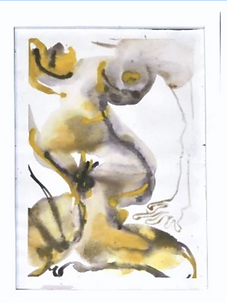
During my process of self-exploration, I chose the distorted female nude as the central image of my artwork. This image holds deep symbolic meaning, representing my resistance to intimacy and the inner struggle I experience when facing vulnerability. As I delved deeper into understanding my emotional world, I realized that my fear of intimacy stemmed from a profound unease with vulnerability. This resistance is not simply an emotional rejection, but rather a conflict and confusion rooted deep within me. The twisted female body thus became a representation of this inner conflict, revealing the emotional turmoil and discomfort I feel in intimate relationships. Through this image, I express my fear of exposing my inner self and the complex emotions I encounter when confronting vulnerability.

The choice of a distorted and fragmented female body is particularly significant as it reflects my struggles with vulnerability and intimacy. These distorted forms are not merely artistic representations of the body, but powerful symbols of my resistance and inner turmoil when it comes to self-exposure and emotional expression. The female body, as a cultural and social symbol, carries rich metaphors of fragility, and this metaphor is accentuated in my work. By distorting and fragmenting the body, I aim to convey the pain and challenges I face when trying to expose my true feelings.
These distorted figures also convey the tension within me—the stark contrast between an outward calm and the inner turmoil that lies beneath. Just as the fluidity of watercolor symbolizes the uncontrollable nature of my emotions, these twisted forms visually represent my inner conflict and contradictions. They are not just physical distortions of the body, but emotional expressions that reveal my fear of accepting and acknowledging my vulnerability. This internal struggle is the key to my self-exploration, understanding my fragility, and ultimately embracing my true self.
In addition to using the distorted body as the core image, I have also placed significant emphasis on depicting hand gestures. Hands, as one of the most expressive parts of the body, carry a wealth of symbolic meaning. In my work, the movements of the hands are not merely physical actions; they carry deeper emotional and psychological expressions. The subtle gestures of the hands often reveal a person’s inner state and emotional fluctuations, especially in the context of vulnerability and intimacy, where hand movements can expose my internal struggles and fears.


The depiction of the hands reflects my relationship with my emotions and how I attempt to maintain control in the face of emotional challenges. Actions like clenching, stretching, swaying, or relaxing the hands all express my resistance, probing, struggling, and surrendering within intimate relationships. These gestures serve as projections of my inner feelings and are also part of my exploration of emotional expression. Through detailed depictions of hand movements, I illustrate how my emotions are either suppressed or released in intimate relationships, constantly torn between fear and desire.
In this process, the hand gestures resonate with the distorted body, and their exaggerated movements together reflect my deep fear of exposing myself. This fear does not only arise from avoiding intimacy, but is intertwined with my fear of authentic emotional expression. Through portraying hand gestures, I explore my emotional boundaries, trying to understand how I can engage with my vulnerability while maintaining my inner integrity in intimate relationships.
Thus, hand gestures are not only an important component of my work, but also a crucial carrier of my emotional expression and psychological processes. Through this nuanced portrayal, I am not just presenting a physical form but also revealing the emotions and inner world hidden within.

Family Background: paternal absence
In my early creative work, I explored family themes, particularly the profound impact of my father’s absence on my personal emotional development. Growing up, my father was almost never present, and my mother’s experience as a single parent led me to develop complex feelings towards the role of the father. Over time, these feelings evolved into skepticism and distrust of male figures, which deeply influenced my intimate relationships and led to anxiety in emotional communication.
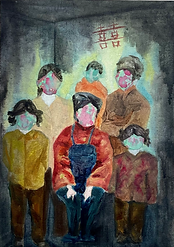
In exploring the role of the father, I read the book The Significance of the Father’s Law, which deeply discusses the pivotal role fathers play in personal psychological development, especially in how fathers mediate the relationship between desire and social norms, and the essential role they play in identity formation and the expression of desires. This perspective aligns with Lacanian theory, which emphasizes the importance of the "Father's Law" in the unconscious and its profound impact on personal identity.
Through understanding these theories, I realized that the absence of a father not only meant a lack of emotional support, but also had negative effects on mental health and social adaptability. The father’s role is not just as an economic provider but also as an emotional and social guide, reshaping family responsibilities while often requiring mothers to take on more decision-making authority. This imbalance in family structure has a deep impact on emotional development and interpersonal relationships, and these complexities became one of the core themes of my work.

The work of feminist scholar Jessica Benjamin further supported my creative exploration. She examines how the absence of the father figure affects family gender dynamics and emotional estrangement. Benjamin’s psychoanalytic feminist framework reveals the shaping influence of parental roles on gender identity, particularly in intimate relationships. These theories helped me better understand how my father’s absence shaped my emotional world and provided me with a framework for exploring selfhood, vulnerability, and the complexities of interpersonal relationships in my creative work.

In my artistic practice, I translate these psychological and emotional states into visual language. Twisted body forms, fragmented images, and layered compositions symbolize emotional fragmentation and inner struggle. These elements are not just representations of personal experience but also artistic expressions of emotional closure and distrust in intimate relationships. As I delve deeper into exploring the absence of my father, I began to focus more on the uncertainty in emotional communication, which led me to emphasize the instability and tension in my work.
This exploration also helped me understand the contradiction between emotional exposure and self-protection. The distorted forms and emotional tension in my work reflect the inner conflict between my fear of exposing my feelings and my desire for self-acceptance. In my creative process, I strive to find a balance, retaining a protective barrier while daring to express emotions. This emotional tug-of-war adds complexity to my work, exploring how to maintain one’s integrity while building deep emotional connections in intimate relationships.


Through this series of creative practices, I not only made breakthroughs in personal emotional expression but also gained a deeper understanding of the theme of my father's absence. I began to realize that art is not just a means of self-expression but also a bridge for emotional connection with others. I gradually understood that my work is no longer just an outpouring of personal emotion; it seeks to provoke reflection and resonance with the audience regarding the inherent contradictions in emotional communication and intimacy.
Artist|Exhibition
Tracey Emin
Emin's work 《The Last Great Adventure is You》 (2014) offers a profound exploration of absence, vulnerability, and the complex emotional impact of paternal loss. Through abstract brushstrokes and emotionally charged forms, Emin conveys her inner struggles and yearning for emotional connection. The work portrays not only feelings of loss and desire but also the process of self-reconciliation. It delves into how, in the aftermath of emotional fragmentation, one seeks healing and rebirth. Emin’s delicate depiction of these emotions invites the viewer to reflect on the process of self-rediscovery, the acceptance of vulnerability, and the eventual embrace of emotional healing.

Her work resonates deeply with my own artistic journey, particularly in addressing the confusion around self-identity and the emotional distance caused by my father's absence. Much like Emin, my creations are an exploration of emotion, especially the ongoing quest for self-identity within the context of a fractured family. 《The Last Great Adventure is You》illuminated for me how the tension of emotional disconnect can be symbolized in art, particularly in the representation of how the absence of parental figures profoundly shapes personal identity. Emin’s courage to confront her pain and transform it into her creative fuel has been an inspiration to me, encouraging me to confront my own emotional vulnerability with greater honesty and clarity.

《I don’t want to have sex because my body feels dead》(2024)
Additionally, Emin's recent works 《I don’t want to have sex because my body feels dead》(2024) and 《I Followed You To The End》 (2024) further explore the complexities of emotion and inner conflict. These pieces depict a raw, almost unavoidable self-exposure, grappling with themes of solitude, self-awareness, love, and loss. Emin’s brash, free brushstrokes convey a sense of breaking, as though releasing the profound pain within. The lines and tones in these pieces create a dynamic tension, with vivid contrasts between bright colors and dark undertones, illustrating both the inner conflict and her desire for emotional connection while also fearing the pain of vulnerability.

《I Followed You To The End》 (2024)
The fluidity and uncertainty in these works struck a deep chord with me, prompting reflections on my own anxieties and insecurities in intimate relationships, particularly the distress caused by emotional detachment. Emin’s work made me realize that emotional exposure is not simply about liberation but about painful self-reflection and intense inner examination. In my own practice, I strive to express this emotional struggle, capturing not just the fluidity and uncertainty of emotions, but also their fractures and tensions. Through this approach, I aim to convey the complexity of emotion, portraying the internal conflicts that mirror my own emotional struggles. Emin’s art has shown me how to channel emotional turmoil into creative expression and how to balance vulnerability with self-protection, daring to face and articulate the emotions that shape my inner world.
In this process, I gradually changed my painting approach, aiming to express emotions more purely. My practice now focuses on breaking away from closed, concrete forms to delve deeper into the uncontrollable and complex nature of emotions, progressively moving away from a dependence on representational shapes. This approach feels liberating, allowing emotions to flow naturally across the canvas rather than being confined by specific imagery.


Kara Walker
Kara Walker’s art intricately explores the impact of race, gender, and family, especially focusing on the emotional and psychological consequences of paternal absence. Her works, such as 《A Subtlety》 (2014) and 《The Emancipation Approximation》 (2013), use powerful visual symbols and narratives to address the legacies of racial oppression and the alienation created by the absence of patriarchal figures. Through sculptures, paintings, and films, Walker reveals how family roles and historical trauma intersect, particularly the emotional gaps left by the lack of father figures, affecting both identity and relationships.

Walker’s portrayal of fatherlessness resonates deeply with my own artistic exploration of similar themes. Like her, I have examined how the absence of a father influences emotional expression and self-identity. While Walker uses symbolic sculpture and silhouettes to represent these complex dynamics, I turn to the fluidity and transparency of watercolor to evoke the ambiguity surrounding paternal absence. The transparent qualities of watercolor mirror the emotional distance and the fragile state of intimacy that comes with a missing father figure.
Through her use of symbolism, Walker helps me understand that the role of a father is not merely a societal expectation but has deep emotional and psychological implications for an individual. Her exploration of how patriarchal absence shapes personal growth and emotional development has inspired my own work, which delves into how these experiences influence one’s understanding of self, intimacy, and gender.
As I continue to reflect on Walker’s symbolic approach to emotional complexity, I’ve come to appreciate that emotional expression can often be conveyed indirectly, revealing hidden truths about inner conflicts. Inspired by Walker’s methods, my future work will further explore how the emotional alienation caused by fatherlessness can be translated visually, emphasizing the tension and conflict over identity that arises from this absence. This exploration will not only reflect my own personal experiences but also offer a broader commentary on how societal and cultural factors shape emotional development within family structures.

Marlene Dumas
Marlene Dumas's works 《MOURNING MARSYAS》 (2024) and 《THE ENEMY》 (2018–2024) powerfully investigate the multifaceted nature of human suffering, emotion, and vulnerability in intimate relationships. Displayed at the Frieze Street Gallery in London, these pieces serve as a reflection on loss, alienation, and the nuanced sadness that emerges from complex emotional experiences. In MOURNING MARSYAS, Dumas references the Greek myth of Marsyas, the satyr who was flayed alive for defying Apollo. This myth embodies themes of betrayal, sorrow, and vulnerability—concepts Dumas conveys by portraying Marsyas as a disfigured, exposed figure. Her depiction of Marsyas evokes a sense of helplessness that mirrors the emotional turmoil one experiences when identities or feelings feel “peeled away,” stripped of protection, and laid bare to the world. It also suggests a reflection on the limitations imposed on personal freedom by societal constraints.


THE ENEMY (2018–2024)
MOURNING MARSYAS (2024)
Dumas’s technique of blurred and somber imagery parallels my own artistic approach of expressing emotional instability through watercolor. Her deliberate manipulation of paint and shape to create a tangible yet ambiguous presence resonates with my aim to depict emotional uncertainty and conflict. In both of our works, technique blends with spontaneity, capturing the delicate balance between control and release in emotional expression. My use of watercolor, with its transparency and fluidity, mirrors Dumas’s portrayal of vulnerability, particularly in intimate relationships where feelings are fluid, fragmented, and often difficult to define. Just as Dumas's works capture the oscillation of emotions, my own artwork attempts to reflect the shifting and unresolved nature of emotional experiences, especially in the context of self-reflection and complex interpersonal dynamics.
Dumas's exploration of emotional complexity continues to influence my practice, particularly through her recent exhibitions, such as *Pareidolia* and *Makapansgat Pebble*. In these works, her blurred figures evoke a sense of ambiguity, a quality that directly parallels my use of fluid, transparent forms to capture the subtleties of emotional fragility. Dumas’s portrayal of fragmented identities through abstraction not only speaks to individual emotional wounds but also addresses the broader historical traumas that shape human experiences. This intersection of personal and collective trauma speaks directly to my own exploration of how familial and societal histories impact identity and emotional expression.

Makapansgat Pebble

Pareidolia
What draws me most to Dumas’s work is her method of conveying emotional states through imperfection. Faces in her paintings often appear obscured or distorted, creating a sense of unfinished identity. This technique resonates with my own exploration of vulnerability, where emotional experiences are not fully defined but are instead layered in complexity. In my watercolor paintings, I employ soft, dissolving layers of color to represent the instability and ambiguity inherent in intimate relationships, echoing the fragmented yet profound emotions that Dumas captures in her figures. Through these layered compositions, I express the emotional contradictions that define human existence—much like Dumas does, unveiling the nuances of human identity and emotional experience through imperfect representations.
Additionally, Dumas’s *Pareidolia*, which explores the psychological tendency to perceive faces in abstract forms, has deepened my understanding of the way emotional perception is shaped by trauma and history. The incomplete faces in *Pareidolia* suggest the fragmented and often unspoken nature of relationships and identities, encouraging me to think about intimacy as a space of constant transformation—sometimes clear, sometimes blurry. This idea aligns with my own approach to expressing the emotional fragments of intimacy, where clarity and ambiguity coexist as integral components of human connection.
In summary, Dumas’s work has been a significant influence in my exploration of emotional contradictions, fragmented identities, and the impact of historical trauma on emotional expression. Her innovative use of abstraction to convey vulnerability, alienation, and the complexities of human emotion resonates deeply with my themes of self-exploration, familial relationships, and the interplay between past and present experiences. Through her work, Dumas has taught me the power of embracing emotional ambiguity as an essential part of the creative process, a lesson I continue to integrate into my own artistic journey.
Just as in my recent creations, I have been inspired by her work and have gradually begun to paint with more freedom. Through watercolor, I capture similar emotional depth, revealing subtle aspects of inner conflicts and fragile self-identity. By employing distorted forms and blurred imagery, my work challenges traditional presentations of the self, aiming to convey the uncontrollable and layered nature of emotions. I want to draw from Dumas’s approach of using abstraction to express pain and complexity, allowing my works to create a hazy space where viewers are invited to feel rather than precisely interpret, evoking shared emotional experiences of intimacy and loss. This creative approach helps me progress on the path of self-discovery, sparking discussions on emotional authenticity, societal expectations, and the nuanced impact of absence on individual identity.


17x24cm
Watercolor
17x24cm
Watercolor
57x80cm
Watercolor
Reference
Benjamin, J., 1988. *The Bonds of Love: Psychoanalysis, Feminism, and the Problem of Domination*. New York: Pantheon Books.
Brennan, B., 1988. *Hands of Light: A Guide to Healing Through the Human Energy Field*. New York: Bantam Books.
Butler, J., 1990. *Gender Trouble: Feminism and the Subversion of Identity*. New York: Routledge.
Butler, J., 1993. *Bodies That Matter: On the Discursive Limits of “Sex”*. New York: Routledge.
Dumas, M., 2024. *MOURNING MARSYAS*. [Painting] Available at: <https://www.marlene-dumas.com>.
Emin, T., 1998. *My Bed*. [Installation] Available at: <https://www.traceyemin.co.uk>.
Emin, T., 2014. *The Last Great Adventure is You*. [online] Available at: <https://www.traceyeminstudios.com> [Accessed 11 November 2024].
Emin, T., 2024a. *i don’t want to have sex because my body feels dead*. [Exhibition] White Cube Gallery, London.
Emin, T., 2024b. *I Followed You To The End*. [Exhibition] White Cube Gallery, London.
Freud, S., 1961. *Beyond the Pleasure Principle*. Translated by J. Strachey. New York: W.W. Norton & Company.
Freud, S., 1965. *The Interpretation of Dreams*. Translated by J. Strachey. New York: Avon.
Gombrich, E.H., 2006. *The Story of Art*. 16th ed. London: Phaidon Press.
Grosz, E., 1990. *Jacques Lacan: A Feminist Introduction*. New York: Routledge.
hooks, b., 2000a. *All About Love: New Visions*. New York: William Morrow.
hooks, b., 2000b. *Feminism is for Everybody: Passionate Politics*. Cambridge: South End Press.
hooks, b., 2002. *Communion: The Female Search for Love*. New York: William Morrow.
Jung, C.G., 1953. *Psychological Aspects of the Persona*. In *Collected Works, Volume 7*. Princeton: Princeton University Press.
Lacan, J., 1978. *The Four Fundamental Concepts of Psychoanalysis*. Edited by J.-A. Miller, Translated by A. Sheridan. New York: Norton.
Lacan, J., 2006. *Écrits: The First Complete Edition in English*. New York: W.W. Norton & Company.
Lear, J., 2005. *Freud*. London: Routledge.
Phillips, A., 1988. *Winnicott*. Cambridge, MA: Harvard University Press.
Salih, S., 2002. *Judith Butler*. New York: Routledge.
Turner, J.M.W., 1842. *Rain, Steam, and Speed – The Great Western Railway*. [Painting] Available at: <https://www.tate.org.uk/art/artworks/turner-rain-steam-and-speed-the-great-western-railway-tw036>.
Walker, K., 2013. *The Emancipation Approximation*. [Exhibition] San Francisco, California.
Walker, K., 2014. *A Subtlety*. [Exhibition] Brooklyn, New York.
Winnicott, D.W., 1965. *The Maturational Processes and the Facilitating Environment: Studies in the Theory of Emotional Development*. New York: International Universities Press.
Winnicott, D.W., 1971. *Playing and Reality*. New York: Tavistock Publications.
Zhuang, W., 2019. *The Role of Watercolor in Contemporary Art Practices*. *Journal of Contemporary Art*, 15(2), pp. 112-128.
email: beverlyjiajia@outlook.com
@kco_beverly
